A kitchenware brand I follow closely had a problem most growing e-commerce businesses recognize: their operations were held together by a combination of spreadsheets, Shopify notifications, and a WhatsApp group where the three founders made decisions in real time about inventory, fulfillment, and customer issues. It worked at ten orders a day. At fifty orders a day it was manageable, barely. At two hundred orders a day, which they hit after a successful product feature on a home cooking podcast, it collapsed. Orders weren’t being fulfilled in sequence. Customer service responses were going out with wrong information. Two team members made conflicting decisions about the same inventory on the same afternoon.
They didn’t need more people. They needed systems that made their existing people more effective.
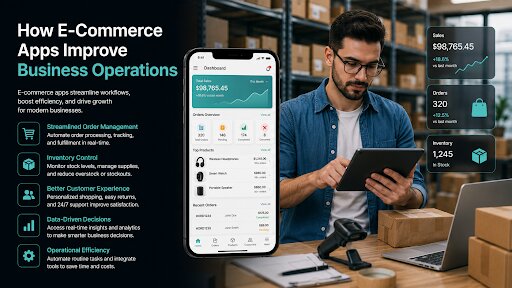
Their mobile app built not just as a customer-facing storefront but as an operational backbone that gave every team member real-time visibility into inventory, order status, and customer communications transformed how the business ran. The chaos of the podcast spike never repeated, because the next spike hit a system designed to handle it.
That’s what e-commerce apps do at their best: not just sell things more conveniently, but restructure how a business operates around information that previously existed in fragmented systems nobody could see simultaneously. A capable eCommerce App Development Company building for this understands that the customer-facing storefront is the visible tenth of the iceberg. The nine-tenths underneath inventory management, order processing, fulfillment coordination, customer data, analytics is where the operational transformation actually happens.
Inventory Visibility That Changes How Decisions Get Made
The kitchenware brand’s inventory problem wasn’t unusual. It’s the default state of e-commerce businesses that have grown past the point where one person can hold the complete inventory picture in their head but haven’t yet built the systems that distribute that picture accurately to everyone who needs it.
Real-time inventory visibility through a mobile app changes the quality of decisions that every person in a business can make. A customer service representative who can see live inventory before promising a customer their order will ship this week gives accurate information rather than optimistic guesses that generate complaints. A buyer who can see inventory turnover rates by SKU, filtered to the past thirty days rather than the past year, makes purchasing decisions calibrated to current demand rather than historical patterns that may no longer apply.
Low-stock alerts that reach the right person through a mobile notification before a product goes out of stock rather than after customers have already ordered something that can’t be fulfilled prevent the customer experience damage that stockouts cause and the operational scramble of managing backorders and refunds. The alert is trivial to build. The prerequisite is inventory data that’s accurate and current in real time, which is the actual technical investment that makes the alert meaningful.
Multi-location inventory management knowing which stock is at which warehouse, which is in transit, and which is committed to pending orders is where growing e-commerce businesses consistently hit complexity that spreadsheet-based operations can’t handle. Mobile apps that surface this multi-location picture at a glance, with drill-down into the details that require investigation, give operations teams the visibility that previously required dedicated inventory management software that nobody could afford before the category democratized.
Order Management Without the Chaos
Order processing in a growing e-commerce business involves more decision points than it appears to from the outside. Which orders get fulfilled from which location. How to handle orders where part of the inventory is available and part isn’t. What happens when a payment fails after an order has started processing. How to manage orders that require special handling fragile items, temperature-sensitive products, oversized shipments that can’t go through standard fulfillment.
Mobile apps that manage order workflows give operations teams visibility into every order in the system, the status of each, and the actions required rather than requiring someone to check multiple systems and email threads to reconstruct the picture. Order prioritization that surfaces time-sensitive shipments express orders, gifts with a specific delivery date, subscription boxes with a window prevents the fulfilment sequence errors that generate complaints from customers who paid for priority handling and didn’t receive it.
Exception handling the orders that fall outside standard processing flows is where most manual time in e-commerce operations gets consumed. An app that routes exceptions to the appropriate team member with the context required to resolve them, tracks resolution, and escalates unresolved exceptions, converts the chaos of “who’s handling the problem order from yesterday” into a managed workflow with clear ownership and accountability.
Returns management is an extension of order management that most e-commerce apps underinvest in. The operational cost of returns receiving, inspecting, restocking or disposing, issuing refunds or exchanges, updating inventory is significant enough that the efficiency of the returns workflow materially affects margins. Mobile apps that guide returns through a structured process, with inspection checklists and disposition decisions made at the point of receipt rather than deferred to batch processing, reduce the per-return cost and the lag between return receipt and inventory availability for resale.
Customer Data That Actually Improves Service
E-commerce customer service is only as good as the information available at the moment of interaction, and the information available at the moment of interaction depends on how well the app consolidates customer data from the sources where it exists.
A customer service representative who can see a customer’s complete order history, their previous support interactions, their contact preferences, and the current status of any open issues without switching between five different systems gives materially better service in less time than one assembling that picture manually during the interaction. The customer experience is better. The representative’s experience is better. The resolution is faster.
Purchase history analysis at the customer level understanding which customers buy frequently at full price versus which buy only on promotion, which have strong category preferences that make recommendations relevant, which have histories of high return rates that warrant additional attention before certain purchases allows customer service and marketing to engage with customers as individuals rather than as tickets in a queue.
Mobile-accessible customer data also changes what’s possible for field teams and sales representatives who interact with customers outside the office. A sales rep visiting a retail account who can pull up that account’s ordering history, their current inventory levels from the brand’s data, and their support ticket history and who can place a reorder or resolve an issue on the spot provides a level of account management that paper-based or laptop-dependent processes can’t match.
Analytics That Reach People When They’re Relevant
E-commerce businesses generate substantial operational data sales by channel, product, time period, geography; conversion rates by traffic source; average order value by customer segment; return rates by product. Most of that data sits in dashboards that get checked when someone remembers to check them, which is rarely at the moment when acting on the information would have the highest impact.
Mobile analytics that surface the right information to the right person at the moment it’s actionable to change how data influences decisions. A daily morning summary pushed to the founder’s phone showing yesterday’s revenue, top-selling products, and any significant anomalies gives them context before they start making decisions, not after a problem has compounded for two days. An alert that fires when a product’s conversion rate drops significantly suggesting a pricing, availability, or competitive issue reaches the person who can investigate while the pattern is fresh rather than after it’s visible in a monthly report.
Among the practical mobile app ideas that consistently improve e-commerce operations, supplier communication tools that connect brands directly with their manufacturers and logistics partners sharing order forecasts, tracking production status, coordinating quality issues address one of the most consistently painful information gaps in product-based businesses. The information that matters for operational decisions about production timing, inventory ordering, and fulfillment commitments frequently lives in emails and WhatsApp conversations that no system can query.
The Integration Layer That Makes All of This Work
Every operational improvement described here depends on data flowing correctly between the systems where it originates and the mobile interfaces where it needs to surface.
An app that shows real-time inventory requires a live connection to wherever inventory is tracked whether that’s a warehouse management system, a fulfillment partner’s API, or a point-of-sale system at physical retail locations. An app that shows order status requires integration with the order management system and the shipping carrier’s tracking data. An app that surfaces customer history requires a connection to the CRM, the support platform, and the order history database simultaneously.
Building these integrations correctly handling the edge cases, the data inconsistencies between systems that have their own data models, the API reliability issues that cause stale data to appear current is where most of the technical complexity in e-commerce app development lives. It’s also where most of the operational value is created, because an app with clean, current data from all relevant systems is a genuinely useful operational tool, and an app with incomplete or stale data creates a false sense of visibility that’s arguably worse than no visibility at all.
What the Kitchenware Brand Built Past the Storefront
Their customer-facing app drove meaningful revenue. The operational layer drove something harder to quantify but equally real: the ability to grow without the operational chaos that had been capping how fast they could scale.
The podcast spike that nearly broke them became a template for how to handle spikes. The next one, larger, went smoothly because every team member had the same picture of inventory, order status, and priorities at the same time. Nobody made conflicting decisions about the same inventory because nobody was working from incomplete information.
They describe the app as having finally given them a business that could grow, rather than a business that was growing faster than it could manage. That’s the operational transformation that e-commerce apps produce when they’re built as operational infrastructure rather than just as storefronts.